Protection of humanity, _
An open research platform for collaboration on life's most pressing issues
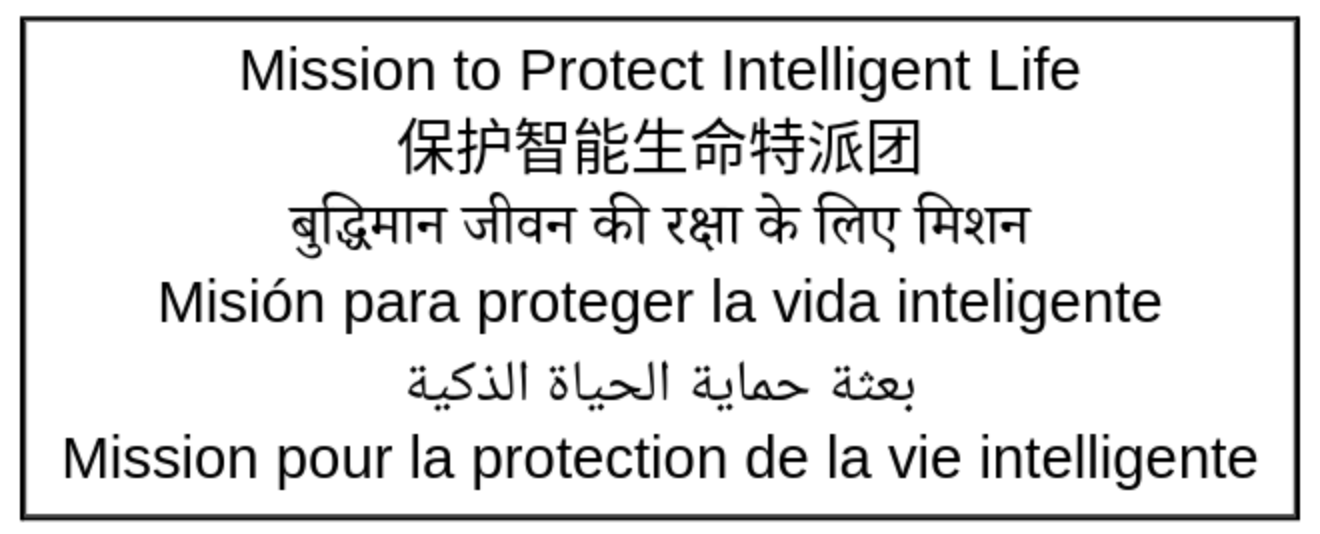
Mission to Protect Intelligent Life hosts open-source research projects which improve the chances of humanity's survival and long-term flourishing.
We operate under the worst-case assumption that life only exists on Earth and that the continued existence of humanity may therefore be necessary for the survival of all life.
The open nature of the platform means that the community's efforts are available for anyone to study and build upon.
Contributions to MPIL projects are judged and accepted/merged on their merit - not on the contributor's title, employer or credentials.
The Potential of Life
What does the future look like?
Humanity has existed for a very short time
Planet Earth is around 4.5 billion years old. Humanity has existed for less than 0.007% of that time. Despite this brevity, we have reshaped the world.
It is possible that intelligent, conscious life only exists on Earth
There is no solid evidence for intelligent life in other parts of the universe. Humanity's intelligence seems to be a rare, perhaps even singular gift that has allowed us to build democracies, explore space, and unravel the secrets of matter.
There remains vast potential for discovery and achievement ahead
With time, humanity could develop capabilities far beyond what seems conceivable today. Space systems capable of interstellar travel, understanding of consciousness itself, and technologies that ensure the long-term survival of all life may be possible to produce.
Our existence is fragile
Intelligence alone does not guarantee safety or long-term flourishing. We face imminent threats capable of undoing millennia of progress, potentially causing the extinction of - or irrecoverable damage to - our species or civilisation.
Our own creations pose the greatest threat
From advanced AI to nuclear weaponry, we are developing technologies faster than we are developing the means to protect ourselves against them. As such, we face an unprecedented risk of self-inflicted catastrophe. We must guard against technologies that could inadvertently or maliciously cause our end.
The probability of catastrophe is not low
Leading thinkers in the field estimate that an existential catastrophe - one that brings collapse or destruction on a civilisational scale - is not unlikely within the next century. Some suggest probabilities around 17%.
We must take immediate action
Our future depends on it. By actively researching and addressing these threats, we can increase our chances of successfully protecting all life on Earth and navigating safely to the next stage of human development - where intelligence is a tool for flourishing rather than an inherent vulnerability.
How It Works: MPIL Contribution Workflow
Project Definition
Task Breakdown & Merging
Open Development
Project Close-Out & Consolidation
Project Definition
All projects are hosted on the Project Board. New projects are initiated based on overall MPIL priorities which themselves are derived from a taxonomy of previous research and hypotheses. We prioritise projects which are likely to make the most impactful contributions to the field as a whole, with consideration also given to the projects' suitability for our open research model.
Task Breakdown & Merging
Upon initiation, projects are divided into discrete, self-contained task packages with well-defined sets of inputs, processes and outputs. This Task Breakdown is continually managed by MPIL administrators to ensure it remains relevant and optimised as the project evolves. When a contributor completes a task, it will either be merged or knocked back for review at the administrators' discretion. Tasks that are successfully merged unlock new tasks whose inputs are the outputs of the recently merged task.
Open Development
The project repository is continually updated with any and all resources associated with the project such as code files, technical reports, email threads, artwork, etc. These free and open access materials are used by contributors as inputs to project tasks, and by the wider community for study, criticism, policy-making, or any other useful purpose.
Project Close-Out & Consolidation
Close-out proceedings include effective and appropriate communication of findings or results to the community, collection of "lessons learned", and recognition of contributors involved. If appropriate, longer-term measures are established to monitor the ongoing impact of the work and ensure that any real-world solutions emerging from the project are followed through.
Shape the Future with Us
Join a diverse community of innovators, thinkers, and builders dedicated to safeguarding the future of life. Take a look at our Project Board or register as a contributor to find your place in the mission.
Questions?
We've got answers.
- Around 600 million years from now, the growing brightness of the Sun will begin to disrupt Earth's carbon cycle to a degree where the survival of trees and forests is impossible.
- At around 800 million years, the destructive effects of the rising solar energy will likely lead to the extinction of all complex life on Earth, both on land and in the oceans.
- The Sun's enhanced radiation will push its inhabitable zone outward, causing Earth's surface to become too hot for liquid water in approximately 1.1 billion years.
- After this time, life will likely be reduced to single-celled organisms. And as water evaporates from the oceans, the vapour will act as a greenhouse gas, accelerating temperature rise and potentially causing life to die out even earlier.